Ikigai may be a Japanese concept on finding one’s raison d’etat, one’s purpose in life but people around the world are fast learning about this ancient philosophy.
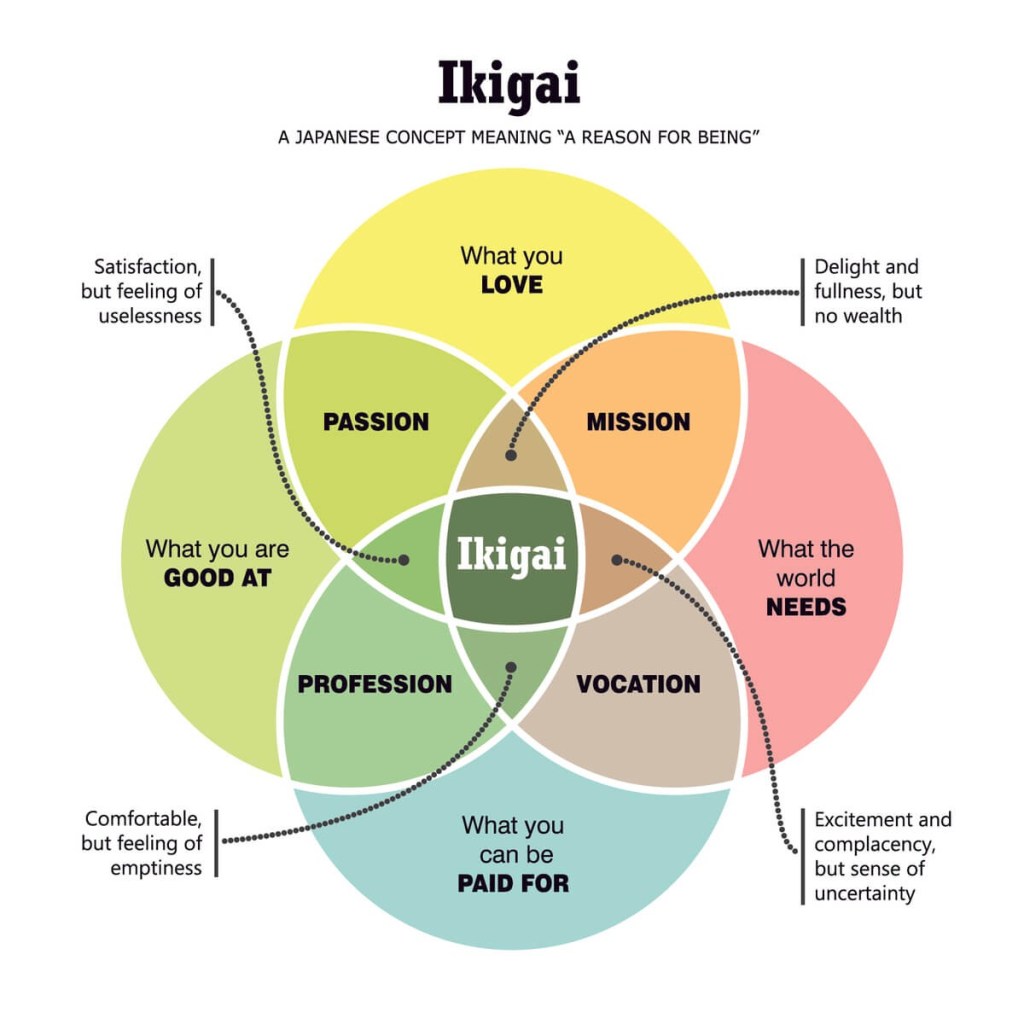
Many probably are already familiar with the above diagram and have embarked on their own personal quests to fulfill the four criteria on their professional journey. This has led some to have the misconception that ikigai can only found through work. Ikigai can also be found through relationships, passion and hobbies, and most commonly through self-realisation.
According to Ken Mogi’s The Little Book of Ikigai, there are five pillars.
- Starting small
- Releasing yourself
- Harmony and sustainability
- The joy of little things
- Being in the here and now
Starting Small
One thing always leads to another. Just like chaos, order can also spread. Completing small little attainable tasks provides feedback to the brain and dopamine is released. This creates a sense of satisfaction in an individual, making him more likely to take on bigger tasks similar in nature. Hence, a momentum will start. For example, making it a habit to make the bed promptly upon the sound of the alarm clock has ceremonial significance on starting the day right. Several small decisions can result in huge consequences.
Releasing Yourself
Releasing oneself refers to the act of giving up the ego. Quite often, the pomposity arising from a self-important ego can create unnecessary pressure and negative feelings. Now with the advent of social media, even more are feeling inadequate because the ego demands validation from external sources. Let humility prevail. Understand that all life have their own purposes. And that purpose is to serve.
Harmony and Sustainability
As human beings, it is in our nature to be gregarious. We do need each other to survive. For harmony to exist, there has to be mutual respect. And this extends beyond relationships between people but also our relationship with the environment. Quantum physics has already proven that all matter is made of energy. Everything is connected in ways we cannot understand. All relationships suffer when there is unbalance. To maintain a sustainable relationship, one has to exercise reservation and restrain when deriving a benefit; and also reciprocate accordingly.
The Joy of Little Things
The folly of youth comes with the delusion that happiness can be found in a well-paying job, marriage, having children and material possessions. As people get older they realise that while all these milestones are great to have in their lives, they can attest that these can be a great source of grief sometimes. The moments in which we laugh are usually rather insignificant and trivial. It is a blessing to be able to appreciate the irony of a silly situation, or to notice the beauty of a short-lived sunset. And it can only happen when there is stillness in the mind.
Being In The Here And Now
Some call this Mindfulness. Staying alert in the present. As if something exciting is about to happen. It is difficult for a mind that is focused in the present to indulge in overthinking. One must agree that an overactive monkey mind will hardly engage in pleasant and constructive thoughts. Fear, regret, worries, suspicions are usually the products. All these can impede productivity or worse, cause accidents due to carelessness. Focusing on the task at hand brings us back to the first pillar of ikigai – starting small. When small tasks are done with extraordinary effort, it can only lead to greatness.
Here’s a happy video. May everyone find their own ikigai which are already inherent inside their hearts.
 Jamessohs